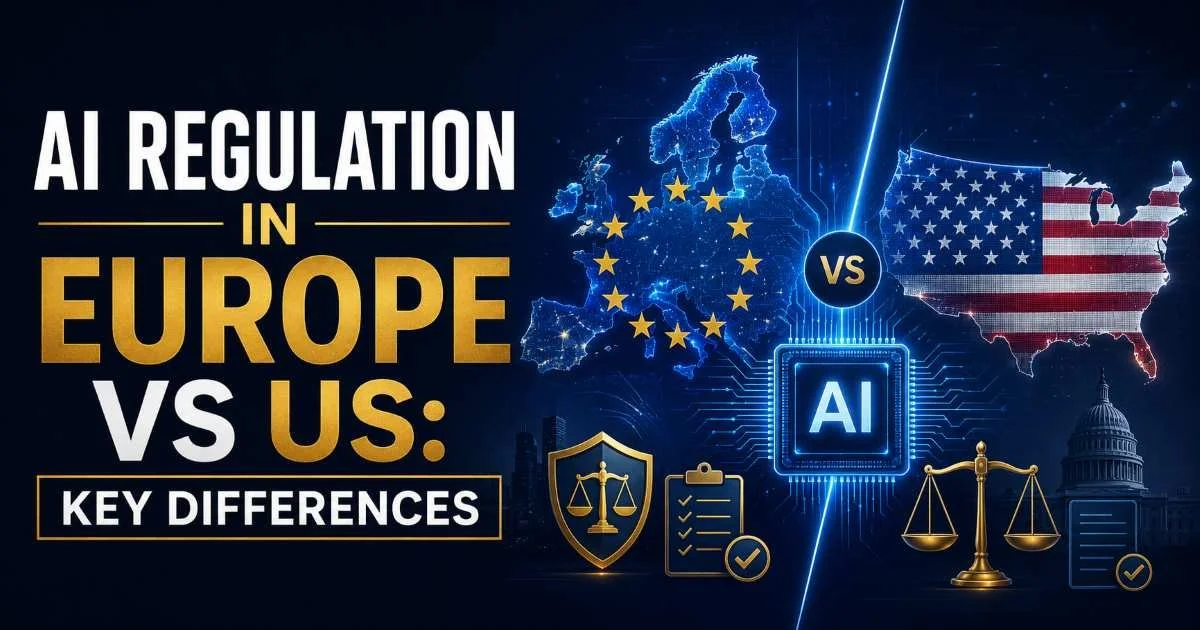
AI regulation across Europe and the United States represents one of the most consequential policy divergences in modern technology governance. For AI compliance officers, understanding these differences is not optional; it's a professional necessity. The EU AI Act compliance framework establishes binding rules with concrete penalties, while the US continues to rely on a patchwork of executive orders, sector-specific guidelines, and voluntary commitments.
Both approaches carry real implications for how organizations build, deploy, and monitor AI systems. Whether you operate in one jurisdiction or both, the regulatory landscape shapes your risk posture, your documentation requirements, and your product roadmap. Getting this comparison wrong can mean missed deadlines, unexpected enforcement actions, or competitive disadvantage.
This article offers a structured, head-to-head breakdown to help you navigate both systems with confidence. If you're still building foundational knowledge, our guide on what EU AI Act compliance actually requires is a strong starting point.
Key Takeaways
- The EU AI Act is a binding, comprehensive law; the US relies on fragmented, sector-specific guidance.
- Risk classification under EU law is mandatory, while US risk assessment remains largely voluntary.
- EU penalties can reach €35 million or 7% of global annual turnover, whichever is higher.
- US enforcement depends on existing agencies like the FTC, FDA, and state attorneys general.
- Organizations operating transatlantically must satisfy the stricter EU standard to avoid dual exposure.
Regulatory Philosophy and Legal Structure
The EU Approach: Prescriptive and Horizontal
The European Union has chosen a comprehensive, horizontal regulatory model with the EU AI Act. This means the regulation applies across all sectors, from healthcare and education to financial services and law enforcement. It creates a single legal framework rather than allowing each industry to self-govern. The regulation entered into force in August 2024, with phased implementation timelines extending through 2027. For compliance officers, this is a hard law with specific obligations, not a set of aspirational principles.
The EU's approach reflects its broader regulatory tradition, which prioritizes fundamental rights and consumer protection. The regulation was modeled partly on the success of GDPR, which set a global standard for data privacy. Lawmakers explicitly designed the AI Act to become a similar international benchmark. Organizations outside the EU that offer AI-powered products or services to EU residents still fall under its scope, creating significant extraterritorial reach.
The Act also establishes new institutional infrastructure, including an EU AI Office within the European Commission. This body will oversee general-purpose AI models and coordinate enforcement across member states. National competent authorities in each EU country will handle market surveillance for most other AI systems. The governance architecture is complex but well-defined, giving compliance officers clear counterparts to engage with.
The US Approach: Sectoral and Market-Driven
The United States has no single, comprehensive AI law equivalent to the EU AI Act. Instead, AI governance relies on existing regulatory agencies exercising their current mandates. The FDA regulates AI in medical devices, the FTC addresses deceptive AI practices, and the EEOC monitors AI-driven employment discrimination. This approach gives agencies flexibility but creates gaps where AI applications don't fit neatly into existing regulatory categories.
At the federal level, Executive Order 14110 (October 2023) represented the most significant step toward coordinated AI governance. It directed agencies to develop standards, required safety reporting for certain foundation models, and promoted responsible AI use in government. However, executive orders are not legislation. They can be revised or rescinded by subsequent administrations, creating regulatory uncertainty that compliance officers must factor into their planning horizons.
State-level activity adds another layer of complexity. Colorado passed a comprehensive AI discrimination law in 2024, and several other states have introduced bills targeting specific AI applications. The result is a fragmented regulatory environment where compliance requirements vary by jurisdiction, sector, and use case. For organizations with national reach, tracking these evolving requirements demands significant resources.
AI Risk Assessment and Classification Frameworks
EU Risk Tiers
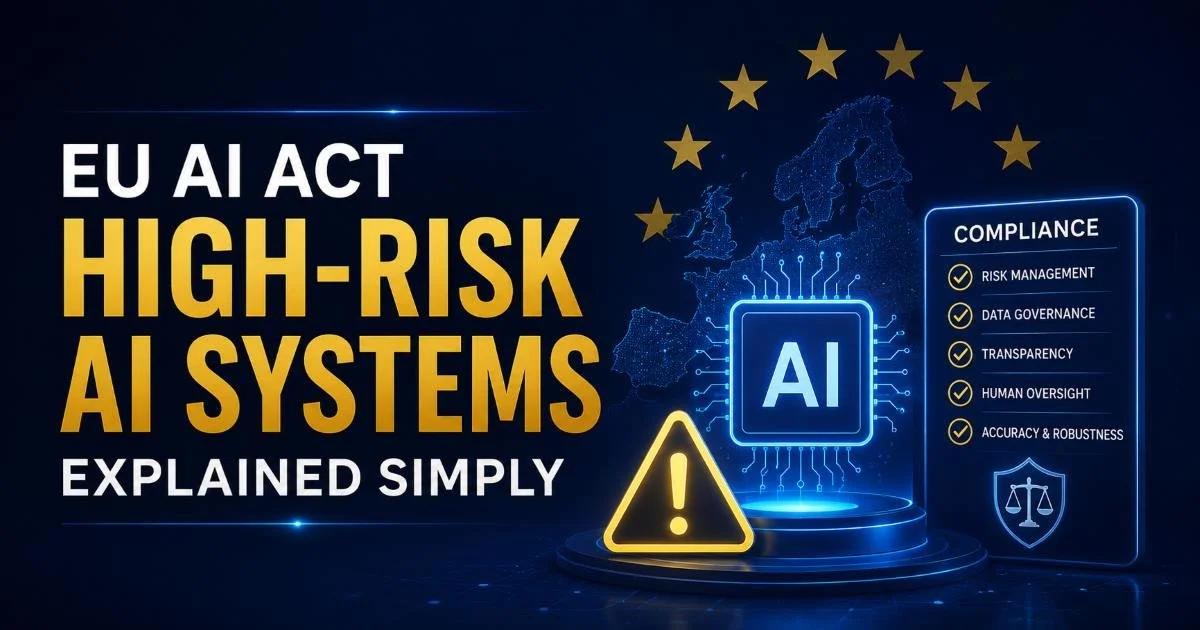
The EU AI Act's defining feature is its tiered risk classification system. AI systems are categorized as unacceptable risk, high-risk, limited risk, or minimal risk. Unacceptable-risk systems, such as social scoring by governments and real-time biometric identification in public spaces (with narrow exceptions), are outright banned. Understanding how high-risk AI systems are classified under the EU AI Act is essential because most compliance obligations concentrate at this tier.
High-risk systems face the heaviest regulatory burden. They must undergo conformity assessments, maintain technical documentation, implement human oversight mechanisms, and meet data quality standards. Examples include AI used in recruitment, credit scoring, critical infrastructure management, and law enforcement. For compliance officers, mapping your AI portfolio against Annex III of the Act is a foundational exercise. If you haven't yet worked through this process, learning how to conduct an AI risk assessment under EU law will give you a practical methodology.
Start by inventorying every AI system your organization deploys, then map each against the EU AI Act's Annex III categories before assessing US-specific obligations.
Limited-risk systems face transparency obligations. Chatbots must disclose they are AI, and deepfake content must be labeled. Minimal-risk systems, which constitute the majority of AI applications, face no specific requirements beyond voluntary codes of conduct. This tiered approach means compliance effort is proportional to potential harm, a design choice that keeps the regulatory burden manageable for most AI applications.
US Risk Landscape
The United States has no equivalent mandatory risk classification system for AI. NIST's AI Risk Management Framework (AI RMF 1.0), released in January 2023, provides a voluntary structure for organizations to assess and mitigate AI risks. It organizes risk management into four functions: Govern, Map, Measure, and Manage. While widely respected, adoption is optional, and there is no penalty for non-compliance with NIST guidelines.
Sector-specific risk requirements do exist. The FDA's regulatory framework for AI and machine learning-based software as a medical device (SaMD) includes a risk-based approach. Financial regulators have issued guidance on model risk management that applies to AI. But these frameworks operate independently, and an AI system used across multiple sectors may face overlapping or contradictory expectations. The regulatory landscape around AI-generated video content and copyright illustrates how quickly new domains emerge that existing US frameworks struggle to address.
The practical difference for compliance officers is significant. Under the EU regime, you must classify your systems and can face penalties for misclassification. In the US, risk assessment is a best practice that protects you in litigation and regulatory inquiries but is not, in most cases, a legal mandate. Organizations that adopt the NIST framework proactively tend to be better positioned when new regulations do emerge.
Enforcement Mechanisms and Penalties
EU Enforcement Architecture
The EU AI Act establishes a clear penalty structure that should command attention from any compliance officer. Violations involving prohibited AI practices can result in fines of up to €35 million or 7% of global annual turnover, whichever is higher. Non-compliance with high-risk system requirements carries fines of up to €15 million or 3% of turnover. Even providing incorrect information to authorities can trigger penalties of up to €7.5 million or 1% of turnover. These figures rival, and in some cases exceed, GDPR penalties.
The EU AI Act's penalty provisions apply to providers, deployers, importers, and distributors. If your organization plays multiple roles in the AI value chain, your exposure multiplies.
Enforcement will be split between the EU AI Office and national market surveillance authorities. The AI Office focuses on general-purpose AI models (like large language models), while member states handle everything else. Each member state must designate at least one national competent authority by August 2025. This distributed enforcement model means that a company could face simultaneous investigations in multiple EU countries, similar to GDPR enforcement patterns.
| Violation Type | Maximum Fine | Turnover Percentage |
|---|---|---|
| Prohibited AI practices | €35 million | 7% |
| High-risk system non-compliance | €15 million | 3% |
| Incorrect information to authorities | €7.5 million | 1% |
| SME/startup violations | Reduced caps apply | Lower of amount or % |
US Enforcement Realities
US enforcement relies on existing agencies using their current statutory authority. The FTC has brought actions against companies for deceptive AI claims under Section 5 of the FTC Act. The EEOC has signaled that AI-driven hiring discrimination falls under Title VII. The CFPB has addressed AI bias in lending decisions. None of these agencies have AI-specific enforcement mandates, but they are actively stretching their existing tools to cover AI harms.
Penalties in the US vary enormously by agency and statute. FTC settlements often involve consent orders and monetary relief but rarely reach EU-scale fines for AI-specific violations. State attorneys general represent a growing enforcement vector, particularly in states with consumer protection statutes that can be applied to AI. The lack of a unified federal standard means enforcement is unpredictable, which paradoxically can make compliance planning harder, not easier.
"Regulatory uncertainty in the US does not mean regulatory safety. It means unpredictable enforcement timing and inconsistent standards."
Private litigation also plays a larger role in the US than in Europe. Class action lawsuits alleging AI-related harm, particularly around bias and privacy, represent a material financial risk. Some legal scholars argue that the US litigation environment, combined with agency enforcement, creates de facto AI regulation even without a comprehensive statute. Compliance officers should monitor both regulatory and litigation trends.
Practical Impact on AI Compliance Officers
Documentation and Audit Burden
The EU AI Act requires extensive technical documentation for high-risk AI systems. This includes descriptions of intended purpose, data governance practices, accuracy metrics, cybersecurity measures, and human oversight protocols. Providers must maintain records of conformity assessments and register systems in the EU database. Using an AI compliance checklist for EU AI Act readiness can help structure this effort and reduce the risk of gaps in your documentation.
In the US, documentation requirements depend on the regulatory context. FDA-regulated AI requires extensive technical files. Financial institutions must document model validation under SR 11-7 guidance. But for many AI applications, documentation is driven by internal governance policies rather than external mandates. The result is that EU-facing compliance officers spend significantly more time on mandatory documentation, while US-focused officers invest in documentation as a risk mitigation strategy rather than a legal requirement.
Even in the US, thorough documentation of AI system design, testing, and monitoring decisions strengthens your position in regulatory inquiries and litigation. Treat it as a necessity regardless of jurisdiction.
Transatlantic Compliance Strategy
Organizations operating in both jurisdictions face a strategic choice. They can maintain separate compliance programs for each market, or they can design a unified program that meets the stricter EU standard globally. Most large enterprises are gravitating toward the latter approach. Aligning with the EU AI Act's requirements tends to satisfy or exceed US expectations, while the reverse is rarely true. This "comply once, deploy everywhere" strategy reduces complexity and operational cost.
Timing matters as well. The EU AI Act's prohibition on unacceptable-risk systems took effect in February 2025. High-risk system obligations phase in by August 2026, with general-purpose AI rules applying from August 2025. US timelines are less predictable, tied to agency rulemaking and congressional action. Compliance officers should build their programs around the EU's concrete deadlines while monitoring US developments for additional obligations that might emerge. A proactive AI risk assessment practice serves both jurisdictions well.
Staffing implications differ too. EU compliance typically requires dedicated roles focused on conformity assessments, CE marking for AI products, and liaison with national authorities. US compliance often involves broader legal and policy teams monitoring multiple agencies and state legislatures. Building a team that understands both systems, or at minimum can translate requirements across jurisdictions, gives organizations a genuine operational advantage.
Frequently Asked Questions
?How do I prioritize EU AI Act compliance if I also serve US markets?
?Does the EU AI Act's extraterritorial reach apply to US-only companies?
?How severe are EU AI Act penalties compared to GDPR fines?
?Is it a mistake to treat US voluntary AI guidelines as effectively optional?
Final Thoughts
The EU and US are pursuing fundamentally different philosophies toward AI regulation, and neither approach is clearly superior in all respects. The EU offers legal certainty and comprehensive coverage at the cost of compliance complexity. The US provides flexibility and innovation space but introduces unpredictability that can be just as expensive to manage.
For AI compliance officers working across both systems, the practical answer is clear: build your program to the EU AI Act standard, then adapt for US-specific requirements where they arise. The organizations that treat this as a strategic investment rather than a regulatory burden will be best positioned for whatever comes next.
Disclaimer: Portions of this content may have been generated using AI tools to enhance clarity and brevity. While reviewed by a human, independent verification is encouraged.